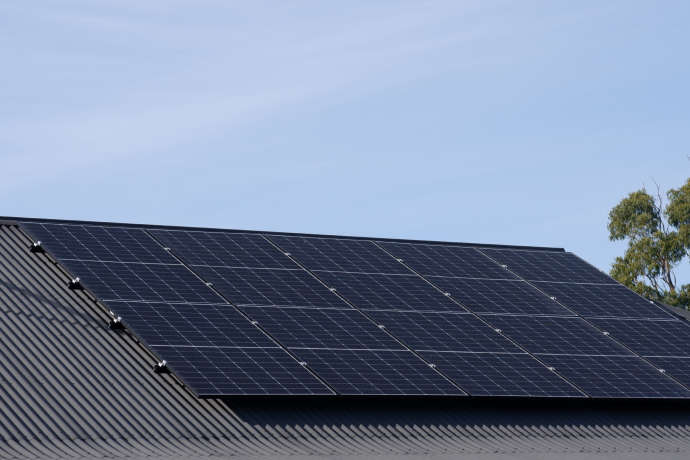



Adding solar panels to your home is one of the smartest investments you can make in Australia. However, to get the most out of your new solar system, it’s crucial to ensure it faces the right direction.
The best direction for your solar panels is north-facing because Australia sits within the southern hemisphere, solar panels that face north receive the most amount of direct sunlight throughout the day. This helps you to maximise the amount of solar energy that is produced. Although there are instances when north-facing may not be achievable, such as when there is unavoidable shade. In these instances, you can still generate energy facing east or west, with east-facing panels effective at capturing the morning sunlight, while west-facing panels are better at receiving the afternoon sun.
When discussing direction, it’s also useful to unpack the importance of your solar panel angle to maximising your performance. Although this will change depending on where you live, Tasmanians should.

Why Does the Direction of My Solar Panels Matter?
Your solar panels aim to generate as much energy as possible. Therefore, you’ll need to position your panels so they face the direction that gets the most amount of sunlight. This is why the direction of your solar panels matters, because it can directly affect how much energy you create.
Which Solar Panel Direction Will Maximise Energy Production?
Choosing the right direction for your solar panels will directly affect your ability to generate energy. The following are some of the major orientations and how they impact your self-consumption:
- North-facing – For most regions within Australia, including Tasmania, north-facing panels are the most effective way to maximise your energy output. This is due to the path of the sun. For a country like Australia in the southern hemisphere, the sun spends most of its time in the northern sky. This means when your panels face north, they capture the most direct sunlight of any direction throughout the day. This can be a great choice for those looking to stay at home during the day, with consistent and reliable energy creation.
- East-facing – East-facing panels produce about 12% less electricity than north-facing panels. Because the sun rises in the east, these panels will produce the most amount of energy during the morning hours and much less during the afternoon. Therefore, if you’re a household that uses a lot of energy during the morning, for things such as breakfast preparation or heating and cooling, then an east-facing setup could be perfect for you.
- West-facing – West-facing panels work similarly to east-facing, producing approximately 12% less electricity than north-facing. However, because the sun sets in the west, these panels are most effective at producing electricity during the afternoon and early evening, reaching their maximum output around 1:30 pm in the afternoon. This may align with many households who have peak energy use in the later hours, during dinner preparation, entertainment and using lighting. Because grid-tied electricity is at its most expensive during the afternoon, those with west-facing panels may create greater cost savings by generating more energy during these peak price periods.
- East and west-facing combination – Also known as an east/west split, you can choose to have solar panels facing both east and west. This is a popular direction for homeowners because it allows you to produce a steady stream of energy. Therefore, east and west-facing systems are well-suited for homes that have a consistently high demand for energy throughout the day, with a more balanced approach.
- South-facing – Putting your solar panels in a south-facing position will result in the lowest amount of energy production. This is the direction that is usually least recommended by solar installers, because it is generally unsuitable for maximising your self-consumption with energy losses of approximately 30%. In rare cases where other directions are not feasible, due to shading or other obstructions, south-facing could be viable. However, your solar installers may try and explore alternative options like ground-mounted systems to ensure you still produce enough energy.
What Factors Will Impact the Best Solar Panel Direction for Me?
There are several key factors that influence the optimal direction for your solar panels. These factors include:
- Geographic Location – Your location within Australia will be crucial to choosing the best direction for your panels. In particular, your individual latitude, which is a measurement of your distance south from the Earth’s equator, is expressed in degrees. Slight adjustments will have to be made to find the ideal orientation and angle based on your specific latitude, which can vary between the northern and southern regions of Australia.
- Shading – Because shading blocks out valuable sunlight from reaching your panels, this should be avoided as much as possible. Even small amounts of shade that strike part of your panels can significantly reduce the total amount of energy you produce. Try to perform a site assessment on your roof to evaluate the effects of shading throughout the day and throughout the year. If you can, try trimming any trees and prioritise areas of your roof that avoid shade.
- Time-of-Day Energy Needs – Arguably, the most critical factor for placement is your personal energy needs. Your solar panels need to be in a direction that matches your personal energy usage habits. For example, if your household uses most of its energy in the afternoon or evening, consider adjusting your panels so they face slightly west. This takes advantage of the sun setting in the east in the later part of the day to ensure you receive enough energy.
- Local Climate – Having an understanding of your local climate may assist you in determining the right direction for your panels. Helpful to consider the unique weather patterns for your location and how they might impact your decision. For example, if you’re someone who lives in a colder region with more overcast days, it’s important that you consider placing your panels in a north-facing position to get as much sunlight absorption as possible. Conversely, you may live in a region that experiences persistent cloudier mornings, meaning west-facing panels are prioritised to get the most out of the afternoon sun.
Does Angle Matter For Solar Panels?
Also called the tilt, the angle of your panels is just as important for maximising energy production as the direction they face. This is because when they are positioned at just the right angle, they can capture as much direct sun as possible during all times of the day, and through different seasons.
Best Angle for Solar Panels
Usually, your solar panels generate the maximum amount of energy when they are positioned perpendicular to the sun. This means that sunlight hits your panels with the most intensity, at a 90° angle. If sunlight is hitting your panels at an angle less than 90°, energy production will be less because the available panel surface area decreases.
However, the best angle for a solar panel will depend on where you live. The ideal angle for your exact location is usually equal to your latitude angle. This means for the best solar results, the pitch of your roof should ideally be equal to the latitude angle, with your panels mounted to the same angle as your roof.
Using Hobart as an example, it is located at a latitude of 43°. This means if you’re looking for the best efficiency, we advise you to ensure your solar panels are tilted at an angle of 43° towards the sun. However, this will be different for different cities. While Sydney residents should have theirs angled at 34°, those in Melbourne should have theirs at 38°. The following table shows the optimal tilt for solar panels in each capital city to receive maximum yields:
| Ideal panel angle (°) | |
| Adelaide | 35 |
| Brisbane | 27 |
| Canberra | 35 |
| Darwin | 12 |
| Hobart | 43 |
| Melbourne | 38 |
| Perth | 32 |
| Sydney | 34 |
It should be noted that these are for north-facing panels. If you’re looking for the optimal solar panel title for other directions, please contact your local solar installer or the team at Tasmanian Safer Solar (TSS).
Best Solar Panel Direction In Each Capital City
Because Australia is in the Southern Hemisphere, our capital cities will experience the sun mostly directed from the north. This maximises the amount of solar energy generated. While east or west may also generate decent yields, you’re still going to lose between 10-20% in energy efficiency when not having your panels face north. The following table shows how the energy efficiency of panels is affected by different directions, based on the major capital cities across Australia:
| Sydney | Melbourne | Perth | Brisbane | Hobart | Adelaide | Darwin | |
| North | 99% | 99% | 99% | 100% | 97% | 100% | 99% |
| East | 84% | 83% | 86% | 88% | 81% | 84% | 94% |
| West | 85% | 86% | 86% | 87% | 80% | 86% | 92% |
| South | 68% | 67% | 70% | 74% | 62% | 69% | 82% |
Get the most out of your solar panels by ensuring they point in the best direction for your home. Usually, most homeowners will get the maximum energy production with panels oriented to the north. However, sometimes, because of shading or the way your roof is designed, north-facing solar panels may not be possible. In these instances, west and east are also viable options, although they will come with a reduced energy output. It’s also important when discussing direction to consider the angle of your solar panels. For people in Tasmania, we recommend prioritising a tilt of 43°. For assistance with finding the optimal solar panel direction for your home, please contact the experts at TSS for more information.

 1300 655 808